If you’ve started shopping for a fiber laser cutting machine, you’ve probably run into the same wall every buyer does: every supplier quotes a different wattage for what sounds like the same job. One vendor tells you 1kW is enough. Another insists you need 6kW “to be safe.” Somewhere in between, you’re left wondering what you’re actually paying for.
Here’s the short answer: wattage determines how thick a material you can cut, and how fast you can cut it — but more power isn’t automatically better for your business. Buying more wattage than your work requires means paying more upfront and burning more electricity for no real gain. Buying too little means your machine struggles on thicker jobs, cuts slower than it should, and leaves you outsourcing work you should be doing in-house.
This guide breaks down exactly what each wattage class — 1kW, 2kW, 3kW, 4kW, and 6kW — is actually built for, so you can match the machine to your material instead of guessing.
Why Fiber Laser Wattage Matters in the First Place
A fiber laser cutter works by focusing a high-intensity beam onto the metal surface, melting or vaporizing the material along a precise path. The wattage of the laser source is essentially the horsepower of that beam.
Higher wattage gives you:
- Greater cutting depth — thicker metal becomes cuttable without multiple passes
- Faster cutting speed — even on materials within a lower-power machine’s range
- Cleaner edges on thicker sheets — less dross, less secondary finishing
- Better performance on reflective metals like aluminum, copper, and brass, which resist lower-power beams
But wattage isn’t the only variable. Cutting speed, assist gas (oxygen, nitrogen, or compressed air), nozzle design, and even the quality of the cutting head all affect the final result. Two machines with identical wattage can perform very differently depending on these factors. Still, wattage is the single biggest lever for determining your practical thickness ceiling — so it’s the right place to start.
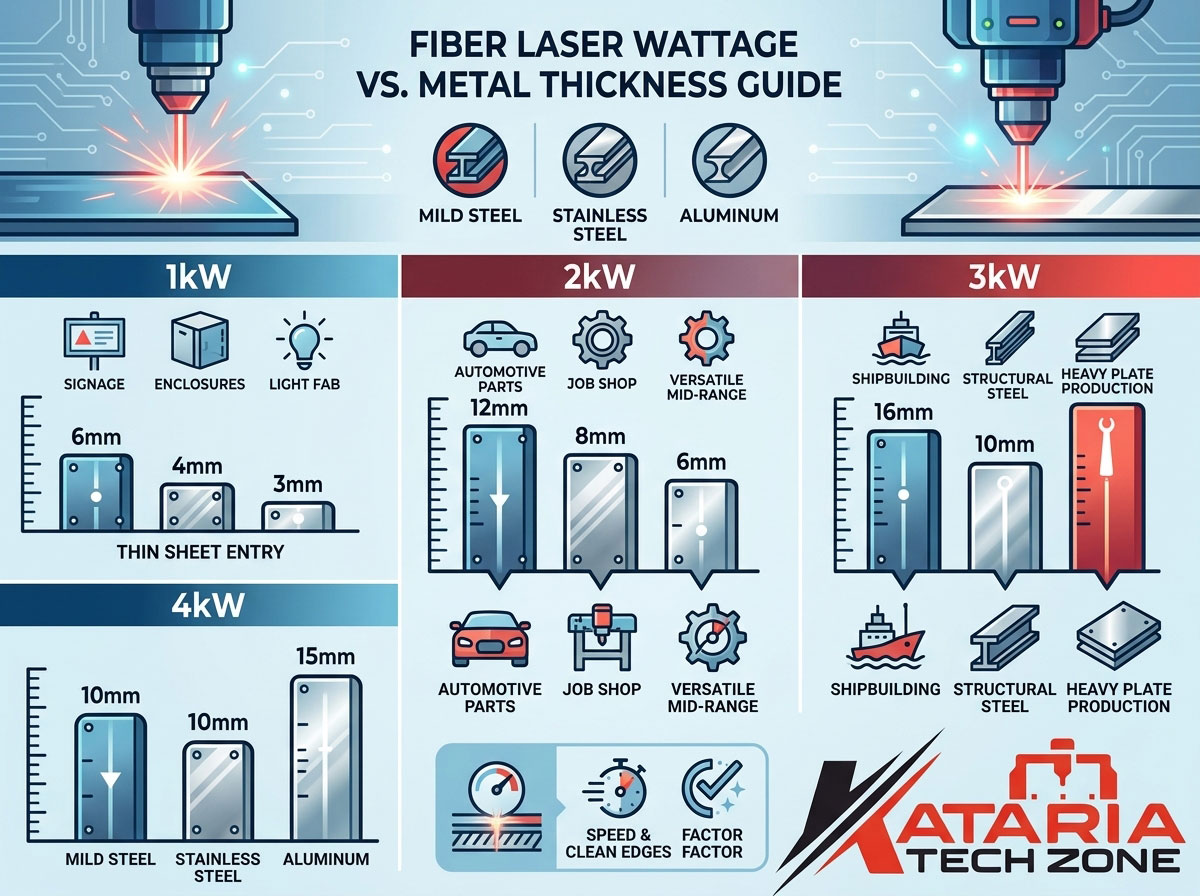
Quick Reference: Fiber Laser Wattage vs. Metal Thickness
These are practical, real-world working ranges for clean, production-quality cuts — not the absolute maximum a machine can technically manage in a single slow pass.
| Wattage | Mild Steel | Stainless Steel | Aluminum |
|---|---|---|---|
| 1kW | Up to 6mm | Up to 3–4mm | Up to 2–3mm |
| 2kW | Up to 12mm | Up to 8mm | Up to 6mm |
| 3kW | Up to 18–20mm | Up to 12mm | Up to 10mm |
| 4kW | Up to 22–25mm | Up to 16mm | Up to 14mm |
| 6kW | Up to 25–30mm | Up to 20–25mm | Up to 18–20mm |
Aluminum, copper, and brass are more reflective and thermally conductive than mild steel, which is why they typically need noticeably more power to cut cleanly at the same thickness.
1kW Fiber Laser: The Entry Point for Thin Sheet Work
A 1kW fiber laser is built for shops working primarily with thin sheet metal — think signage, enclosures, brackets, HVAC ductwork, electrical panels, and light fabrication.
Best for:
- Mild steel up to roughly 6mm
- Stainless steel up to roughly 3–4mm
- Thin aluminum sheet work
Where it fits: Small fabrication shops, sign-making businesses, job shops that mostly handle thin-gauge material, and businesses just transitioning from CO2 or plasma cutting to fiber laser. It’s the lowest upfront investment and the lowest running cost in the fiber laser range, which makes it a common first machine for growing shops.
Where it falls short: If your order book regularly includes anything above 6–8mm mild steel, a 1kW machine will bottleneck your production — either by requiring multiple passes or simply being unable to complete the cut cleanly.
2kW Fiber Laser: The Versatile Mid-Range Workhorse
2kW is where most general fabrication shops land, because it comfortably covers the thickness range most everyday jobs actually require.
Best for:
- Mild steel up to roughly 12mm
- Stainless steel up to roughly 8mm
- Aluminum up to roughly 6mm
Where it fits: General metal fabrication, automotive parts, furniture hardware, machine enclosures, and mixed-material job shops that need flexibility across both thin and moderately thick stock. This is often the sweet spot for shops that don’t want to specialize narrowly but also don’t need heavy-plate capability.
3kW Fiber Laser: Serious Production Capability
At 3kW, you start cutting into genuinely thick material territory while still keeping speed and running costs reasonable.
Best for:
- Mild steel up to roughly 18–20mm
- Stainless steel up to roughly 12mm
- Aluminum up to roughly 10mm
Where it fits: Structural steel fabrication, industrial equipment manufacturing, heavier automotive and machinery components, and shops running higher production volumes where cutting speed on mid-thickness material directly affects throughput and delivery timelines.
4kW Fiber Laser: Bridging Mid and Heavy-Duty Cutting
4kW machines sit between the mainstream 3kW class and the heavy-duty 6kW class, offering a noticeable jump in both thickness capability and cutting speed on mid-range material.
Best for:
- Mild steel up to roughly 22–25mm
- Stainless steel up to roughly 16mm
- Aluminum up to roughly 14mm
Where it fits: Shops that regularly deal with structural components, heavy machinery parts, and thicker stainless or aluminum work, but don’t yet need the extreme thickness range of a 6kW system. It’s also a strong choice for shops looking to significantly cut cycle times on 8–15mm material compared to a 2kW or 3kW machine.
6kW Fiber Laser: Heavy Plate and High-Volume Production
6kW (and above) is squarely industrial territory — built for shops that live in thick plate and can’t afford to compromise on cutting speed.
Best for:
- Mild steel up to roughly 25–30mm
- Stainless steel up to roughly 20–25mm
- Aluminum up to roughly 18–20mm
Where it fits: Heavy fabrication, shipbuilding-adjacent work, construction equipment manufacturing, structural steel producers, and high-volume production floors where speed on thick material translates directly into revenue. The higher upfront cost and power consumption are usually justified only when thick-plate work is a consistent, not occasional, part of your order flow.
Factors Beyond Wattage That Affect Your Decision
Wattage sets your thickness ceiling, but several other factors determine how well a machine performs day-to-day:
Assist gas type
- Oxygen assist increases cutting speed on mild steel but leaves an oxidized edge
- Nitrogen assist produces a clean, oxide-free edge but is slower and increases gas consumption
- Compressed air works for thinner materials and lowers running costs
Cutting speed requirements If your shop runs high order volumes, a slightly higher wattage than your minimum thickness requirement can pay for itself through faster cycle times, not just thicker-cut capability.
Material mix If your work is mostly mild steel, you can often run a lower wattage than a shop cutting a lot of stainless steel or aluminum at the same thickness, since reflective and conductive metals demand more power for the same result.
Bed size and automation Wattage matters, but so does whether the machine supports exchange tables, automated loading, or integration with your existing production line — especially as volume scales.
Duty cycle and future growth It’s worth sizing your machine slightly above your current needs if you expect your material thickness or order volume to grow over the next few years, since upgrading later means a full new machine purchase, not a simple retrofit.
A Simple Framework for Choosing Your Wattage
- List your actual job mix — not the thickest job you’ve ever done, but what you cut on a regular, recurring basis.
- Identify your ceiling material — the thickest metal type and gauge that shows up regularly, not as a rare exception.
- Match that ceiling to the wattage table above, then round up one tier if you expect growth or frequently work with reflective metals.
- Weigh running costs against thickness headroom — higher wattage machines cost more to run, so don’t over-buy capability you’ll rarely use.
- Talk to a manufacturer who can size the machine to your shop, not just sell you the highest number.
Common Mistakes When Choosing Fiber Laser Wattage
- Buying based on a single worst-case job instead of your regular workload, leading to an oversized, underutilized machine
- Ignoring material type and sizing purely on mild steel specs, then struggling with aluminum or stainless jobs
- Underestimating growth and being locked into a machine that can’t keep up within a year or two
- Overlooking assist gas and speed requirements, which affect real-world throughput as much as raw wattage does
Why Choose Kataria Tech Zone for Your Fiber Laser Machine
At Kataria Tech Zone, we manufacture and supply fiber laser cutting machines across the full power range — from entry-level 1kW systems to heavy-duty 6kW+ production machines — built for Indian manufacturing conditions with dependable local support, installation, and training.
Rather than pushing the highest wattage available, our team works with you to size the machine to your actual material mix, production volume, and growth plans, so you’re not overpaying for capability you won’t use or under-buying capacity you’ll outgrow in a year.
Explore our full range:
- Fiber Laser Machines — cutting, marking, and engraving systems across all wattage classes
- Laser Machines — our complete fiber and CO2 laser lineup
- Laser Marking Machines — for permanent marking and engraving on metal and plastic
You might also find these related reads useful:
FAQs: Fiber Laser Wattage for Metal Cutting
What wattage fiber laser do I need to cut 10mm mild steel? A 2kW fiber laser handles 10mm mild steel comfortably, though a 3kW machine will cut it faster and give you headroom for thicker jobs down the line.
Is a higher wattage fiber laser always better? No. Higher wattage increases both machine cost and power consumption. If your regular work rarely exceeds thin-to-mid gauge material, a lower wattage machine is more cost-efficient to buy and run.
Can a 1kW fiber laser cut stainless steel? Yes, up to roughly 3–4mm cleanly. Beyond that thickness, cutting quality and speed drop off significantly, and a 2kW or higher machine is a better fit.
Why does aluminum need more laser power than mild steel at the same thickness? Aluminum is more reflective and thermally conductive, meaning it dissipates and reflects laser energy more than mild steel does, so a stronger beam is needed to achieve the same clean cut at equal thickness.
Should I buy extra wattage for future growth? If you expect your material thickness or production volume to increase within the next 2–3 years, sizing one tier above your current minimum requirement is usually more cost-effective than replacing the entire machine later.
Ready to find the right fiber laser wattage for your shop? Contact Kataria Tech Zone for a free consultation based on your actual production needs — not just the biggest number on the spec sheet.